TL;DR
-
AI in telecom applies features like chatbots, sentiment analysis, smart call routing, and automated follow-up to contact centers and UCaaS platforms, giving businesses faster and more consistent customer service.
-
Integrating AI well matters more than simply adopting it, because a chatbot cut off from your CRM and order history can only resolve surface-level requests.
-
The strongest AI deployments route routine questions to automation and hand complex or sensitive cases to human agents early, raising capacity without eroding customer trust.
-
When comparing providers, weigh integration depth, transparent AI claims, training support, and true total cost rather than feature lists, because pricing models often hide the real spend.
Contact centers are under pressure to keep up with rising call volumes, despite support teams being stretched thin, and customer frustration growing with every minute they wait. AI for telecommunications promises to relieve this pressure through chatbots, intelligent routing, real-time sentiment analysis, and automated follow-up.
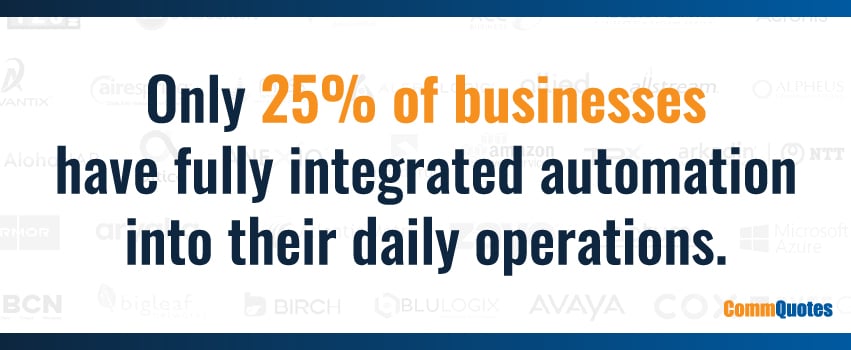
The shift toward telecom AI use cases is already widespread. A 2025 survey found that 98% of contact centers already use AI in some form.1 However, only 25% have fully integrated automation into their daily operations2 – and this gap between adoption and effective implementation is where most organizations struggle.
In this guide, we’ll break down the role of AI in telecommunications, the use cases driving real results, and the practical implications for your business.
What Is AI in Telecom?
AI in telecom is the application of intelligent features to contact centers, UCaaS, and other communications solutions. A few examples of this are:
- Chatbots that resolve routine issues automatically
- Sentiment analysis that flags frustrated customers
- Call routing to connect customers to the right agent faster
- Automated follow-up without human intervention
For businesses, this means better uptime, more consistent connectivity, and a communications infrastructure that adapts to demand in real time.
How Are Businesses Using AI Telecommunications to Improve Customer Experiences?
Contact center solutions are increasingly incorporating AI as a core capability. Here's where AI is creating the most value for organizations:
AI-Powered Chatbots and Virtual Agents
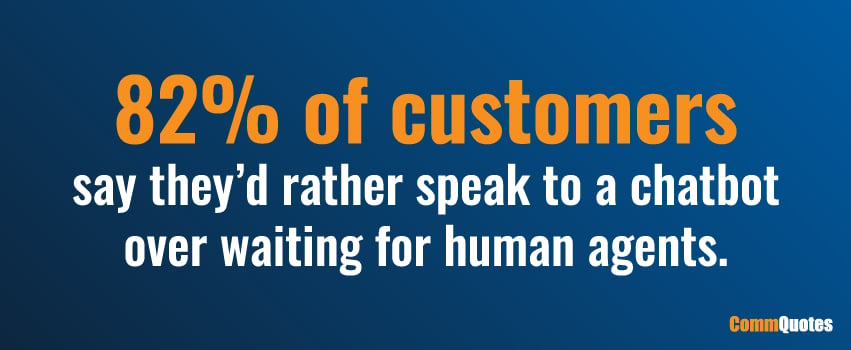
Chatbots handle routine inquiries, such as account balance inquiries, password resets, order status checks, and appointment scheduling. Customer preference for this approach is clear, with 82% of customers saying they’d rather speak to a chatbot over waiting for human agents.3
The difference between effective and ineffective chatbot implementations often comes down to integration depth. A chatbot with access to complete customer data can resolve many inquiries end-to-end without escalation, while one that can’t access customer history frustrates customers and creates extra work for agents who must help resolve issues the chatbot could not.
Real-Time Sentiment Analysis
AI can listen to calls in real time and alert supervisors when a customer becomes frustrated, enabling intervention before the call escalates into a complaint or a lost customer relationship.
Agents also see sentiment indicators during the call, helping them adjust their approach when they recognize frustration building. This combination of automated detection and human responsiveness prevents call failures before they occur.
Intelligent Call Routing
Intelligent call routing analyzes calls and connects customers to the best agent to handle their specific issue. For example, Spanish-speaking customers route to Spanish-speaking agents, billing questions route to billing specialists, and complex issues route to senior agents.
This approach helps to reduce wait time, improve first-contact resolution, and make your customers feel heard faster – rather than shuffled through a generic queue.
Automated Follow-Up
After a support interaction, AI can send automated follow-up messages confirming next steps, providing additional resources, or scheduling callbacks. This keeps customers informed without requiring agent time and improves customer experience perception through consistent, timely communication that would otherwise require manual effort.
Telecom AI Use Cases That Enhance Internal Communications and Collaboration
Modern UCaaS platforms also include AI capabilities that directly improve how teams work together:
- Intelligent meeting transcription and summarization automatically create meeting notes and action items, saving administrative time that can be redirected toward higher-value work.
- Presence intelligence helps teams understand who is available for collaboration, reducing time spent trying to reach colleagues and improving team responsiveness.
- Call recording with AI-powered search lets you find specific moments in recordings by searching keywords, making training and quality assurance significantly faster and more thorough.
- Meeting insights flag important decisions made during calls and help ensure follow-through on commitments made during conversations.
These features make teams more efficient and help capture institutional knowledge that would otherwise stay trapped in individual team members' notes or memories. Don't have time to evaluate each vendor's AI capabilities? CommQuotes can help you skip the sales pitches and find right-fit solutions that deliver real collaboration improvements.
Challenges of Adopting AI in Contact Centers and UCaaS
Most contact center and UCaaS platforms now include AI features, but turning them into results is where businesses stall. The gap between buying AI and using it well comes down to a few practical challenges.
Data Quality and Integration
AI is only as good as the systems it can reach. A chatbot cut off from your CRM, helpdesk, and order history handles surface-level questions and little else, which is a big reason nearly all contact centers report using AI while far fewer have it fully integrated. Connected data is the difference between resolving an issue and escalating it.
Customer Trust and Over-Reliance
Some customers still resist bots, especially on sensitive or complex issues. Push automation into interactions that need a person and you erode confidence fast. The better setups send routine questions to AI and hand harder cases to agents early.
Cost and ROI Uncertainty
AI features often hide inside per-user pricing or arrive as paid add-ons, so the real cost is hard to read from a quote. Without a clear view of which use cases save money, teams pay for capabilities they never switch on. Tie each feature to a measurable outcome like lower handle time or higher first-contact resolution.
Change Management and Training
Poor configuration, not the technology, is usually why AI disappoints. Agents need to know when to trust a sentiment prompt and when to override it, and supervisors need time to tune routing rules. Budget for onboarding and iteration, not just the license.
What To Look for When Evaluating AI Telecommunications Providers
Not all contact center and UCaaS solutions implement AI equally. Here’s what to look for when comparing AI solutions:
Integration Depth
Does the AI integrate with your CRM, helpdesk, and knowledge base? An AI chatbot that can’t access customer history is less useful than one that can see previous interactions, account status, and known issues.
Transparency
Vendors claiming their AI features solve every problem are overselling capabilities that will likely disappoint during implementation. Look for vendors that candidly discuss where their AI features can and cannot help, and what human involvement remains necessary.
Implementation Success
Ask the vendor for examples of how their customers are using the AI features and what outcomes they achieved. Get references from customers operating at your scale, and verify the claims independently rather than relying on vendor claims alone.
Training and Support
Will the vendor help you configure AI features properly? Poor configuration is often the reason AI implementations disappoint. Look for vendors that include implementation support and training as part of their offering, not as add-ons.
Scalability
Does the solution handle your current call volume or team size without degrading performance? Equally important is understanding how the solution will perform as you add capacity.
Cost Model
Vendor pricing models can obscure true total cost of ownership. Does the AI require per-user licensing or unlimited use? Make sure you understand the full cost structure across initial deployment, ongoing fees, and expansion scenarios.
AI in Telecom FAQs
What Is AI In Telecom?
AI in telecom is the use of intelligent features inside communications tools like contact centers and UCaaS platforms. In practice it means chatbots that resolve routine requests, sentiment analysis that flags frustrated callers, call routing that matches customers to the right agent, and automated follow-up. For businesses, it translates into faster service, more consistent support, and a communications setup that adapts to demand.
Will AI Replace Human Contact Center Agents?
No. AI handles high-volume, routine work such as password resets, order status, and appointment scheduling, which frees agents for complex or sensitive cases that need judgment and empathy. The most effective contact centers pair the two, letting automation deflect simple requests and routing harder issues to people early. The goal is to raise agent capacity and first-contact resolution, not to remove the human element.
How Much Does It Cost To Add AI To A Contact Center Or UCaaS Platform?
It depends on the platform and how the AI is packaged. Some vendors bundle AI into per-user licensing, while others sell features like transcription or advanced routing as add-ons. Because pricing models differ, the sticker figure rarely reflects true total cost across deployment, ongoing fees, and expansion. Focus on the use cases that drive measurable savings, such as lower handle time, and price the AI against those outcomes rather than the feature list.
What Are The Main Challenges Of Adopting AI In Contact Centers?
The biggest challenges are data quality and integration, customer trust, cost clarity, and change management. AI that cannot reach your CRM and order history only answers surface-level questions. Customers may resist bots on sensitive issues, so automation needs a clean handoff to agents. Pricing can obscure true cost, and poor configuration, rather than the technology, is the usual reason projects underperform. Training and iteration close most of that gap.
How Does AI Improve Customer Experience In Contact Centers?
AI improves customer experience by cutting wait times and making support more relevant. Chatbots resolve common requests instantly, sentiment analysis alerts supervisors when a call is going sideways, and intelligent routing connects customers to the agent best suited to help, such as a billing specialist or a Spanish-speaking rep. Automated follow-up keeps people informed after the interaction without adding to agent workload.
Is AI In Telecom Only For Large Enterprises?
No. AI features are now standard in most cloud contact center and UCaaS platforms, so businesses of any size can use them. Because many capabilities are priced per user or included in a subscription tier, a small team can access chatbots, transcription, and smart routing without enterprise-scale budgets. What matters more than company size is choosing features that fit your call volume and connecting them to the systems you already run.
Navigate the AI-Powered Telecom Landscape With CommQuotes
Evaluating AI in telecom solutions like contact centers and UCaaS is inherently complex. You need to understand your operational needs, compare vendors on features that matter to your business, and negotiate pricing that reflects real value rather than list price. This evaluation requires expertise that most organizations lack, and poor selection decisions can create years of friction and cost overruns.
At CommQuotes, our vendor-agnostic advisors help businesses evaluate and source connectivity, communications, and cybersecurity solutions from 450+ vetted providers – including those at the forefront of AI-powered capabilities. We cut through the vendor noise to find the right fit for your environment, at better-than-direct pricing and zero cost to you.
If your organization is re-evaluating its technology infrastructure to improve customer experiences, we'd love to be part of that conversation. Connect with our team today to get started.
Sources: