Not every business location has access to fiber, and even locations that do sometimes need a reliable backup for when that primary connection goes down. Fixed wireless access has become one of the fastest-growing answers to both problems, with FWA projected to make up more than 35% of all new fixed broadband connections worldwide by the end of 2030.1
Understanding how the technology works can help you decide if it belongs in your connectivity strategy. In this guide, we’ll break down what fixed wireless access is, how it works, its pros and cons, and how to find the right FWA provider for your needs.
What Is Fixed Wireless Access?
Fixed wireless access, or FWA, is a business internet service that uses a wireless radio connection to complete the last-mile connection between a carrier’s network and the customer premises.
In a typical deployment, the carrier has fiber at a nearby point of presence (PoP), tower, rooftop, or other network location. Instead of extending that fiber underground all the way to the customer’s building, the carrier uses a line-of-sight radio connection to bridge the remaining distance – avoiding trenching, permitting, and other construction required to extend new fiber to your building.
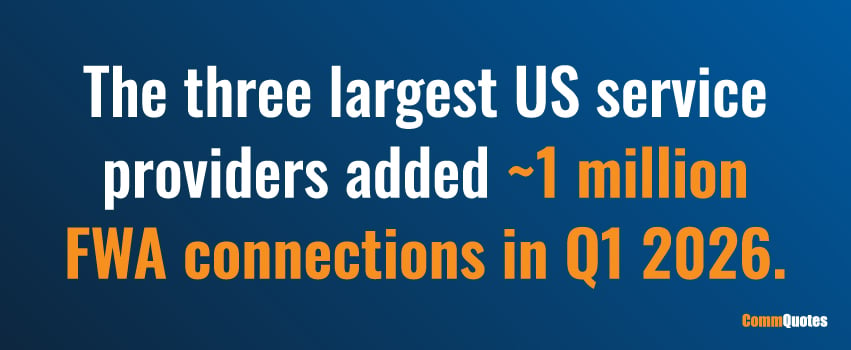
FWA has grown quickly because it solves a real gap in the market. In fact, the three largest US service providers added almost 1 million net FWA connections in the first quarter of 2026 alone.2
How Fixed Wireless Access Works
A fixed wireless access setup relies on three basic components:
- Fiber reaches the carrier’s POP, tower, or rooftop.
- Directional radio equipment transmits the circuit to the customer location.
- A receiver at the customer premises connects the service to the customer’s router, firewall, or LAN.
Once installed, the equipment functions much like any other internet connection from the user's perspective.
Fixed Wireless Access Architecture Explained
Fixed wireless access architecture is simpler than most wired alternatives, which is part of why deployment moves so quickly. A typical setup requires a direct or near line of sight between the customer's receiver and the provider's tower, though newer non-line-of-sight technology is expanding to allow for more flexible FWA deployments.
Because FWA doesn't require trenching cable or negotiating right-of-way agreements with municipalities, it can be installed in a fraction of the time it takes to extend fiber to a new location.
Fixed Wireless vs. Mobile Wireless
Fixed wireless and mobile wireless both use radio technology, but they serve very different purposes.
- Mobile wireless provides broad geographic coverage to devices that move. The network supports many users across a large area and allows devices to transition between serving network sites.
- Fixed wireless creates a permanent connection between two known locations. Directional radio equipment is installed at the carrier location and customer premises and aligned to create a stable path.
Essentially, mobile wireless brings the network to a moving device, while fixed wireless creates a permanent wireless bridge between the carrier’s network and a specific building.
Fixed Wireless Access Broadband vs. Other Connectivity Types
Understanding fixed wireless access broadband means understanding how it compares with alternatives:
Fiber
Fiber, which transmits data as light through underground cables, is still the gold standard for businesses. Unfortunately, fiber can be expensive and slow to deploy – particularly in rural areas where digging and permitting can take months or years. Fixed wireless internet access fills that gap, often available in days rather than months, without any digging required.
Satellite
Satellite internet beams connectivity from orbiting satellites to a dish installed at the customer's location, making it available virtually anywhere with a clear view of the sky. FWA delivers lower latency and better weather resistance than satellite options, since the signal only travels to a nearby tower rather than to space and back.
DSL
Digital Subscriber Line (DSL) sends internet over the same copper telephone lines that homes and businesses have relied on for decades. Compared to DSL, FWA generally offers faster speeds and doesn't depend on aging copper infrastructure, which many carriers are actively retiring.

5G Fixed Wireless Access Market: What's Changed
The rise of 5G fixed wireless access has improved what the technology can deliver compared to its earlier generations. 5G networks offer higher bandwidth, lower latency, and more consistent performance, which has made FWA a more realistic primary connectivity option for many businesses instead of just a stopgap.
As a result, the 5G fixed wireless access market has expanded rapidly. Ericsson forecasts global FWA connections to grow from 185 million at the end of 2025 to 350 million by the end of 2031, with close to 85% of those connections expected to run over 5G.2 That growth reflects both expanding 5G coverage and rising demand from businesses looking for faster deployment and lower installation costs than traditional wired options.
What Are the Pros and Cons of Fixed Wireless Access?
Like any technology, FWA comes with strengths and trade-offs, and an honest look at both sides will tell you whether it fits your situation:
Pros
- Available in areas where fiber isn’t extended to the building
- Faster and often more affordable to deploy than fiber or cable
- Physical-path diversity from underground connectivity
- Lower latency than satellite solutions
- Works well as a backup or failover option
- Minimal installation complexity, often plug-and-play
- Temporary connectivity while fiber or another circuit is installed
Cons
- Generally needs LOS to the nearest tower, though this is improving
- Performance can be affected by severe weather
- Latency, while better than satellite, still typically trails fiber
- Coverage and speed depend on proximity to towers and congestion
What To Look For in Fixed Wireless Access Providers
Not every fixed wireless access provider offers the same coverage, reliability, or pricing, and the right choice depends on your specific needs. When evaluating providers, consider:
Availability
A viable fixed wireless connection may require clear or near line of sight between the provider and your premises. Buildings, trees, terrain, and other obstructions can affect availability.

SLA Commitments
Review the provider’s SLA commitments carefully, especially if you’re using FWA as your primary connection rather than a backup.
Equipment and Installation Costs
Equipment and installation costs vary significantly between providers, so make sure to get the numbers upfront.
Network Congestion
Ask about the provider’s network congestion history in your area, since FWA performance can degrade during peak usage.
Contract Flexibility
Prioritize contract flexibility, especially if you're using FWA as an interim solution while waiting for fiber.
Is Fixed Wireless Access Right for Your Business?
The answer depends on your location. One site may have several fiber options, while another may have limited wired connectivity but excellent fixed wireless availability. That’s why you should evaluate business connectivity location by location rather than forcing every site into the same technology.
Think FWA might be a good fit for one of your locations? Comparing fixed wireless access providers and coverage across dozens of carriers is time-consuming, and coverage quality can vary block by block in ways that generic marketing materials rarely capture.
CommQuotes can help you evaluate fixed wireless, DIA, fiber, broadband, and backup connectivity options across our portfolio of 450+ vetted providers, matching you to the right solution for your specific location and needs – all at no cost to you. If you’re ready to find the right connectivity solution for your business, connect with our team today.
Sources: