%20Examples%20Benefits/commquotes-feat-whatisIaaS.jpg)
If you've spent any time researching cloud solutions for your business, you've probably run into the term IaaS – and maybe glossed right past it. You're not alone. Cloud jargon can pile up fast, but infrastructure as a service is one concept worth understanding – especially since getting it wrong can mean overpaying, underperforming, or locking yourself into solutions that don't scale.
In this guide, we'll break down the IaaS definition, walk through real-world IaaS examples, and explain the key benefits that make it one of the most popular cloud service models for businesses today.
IaaS Definition: What Is IaaS?
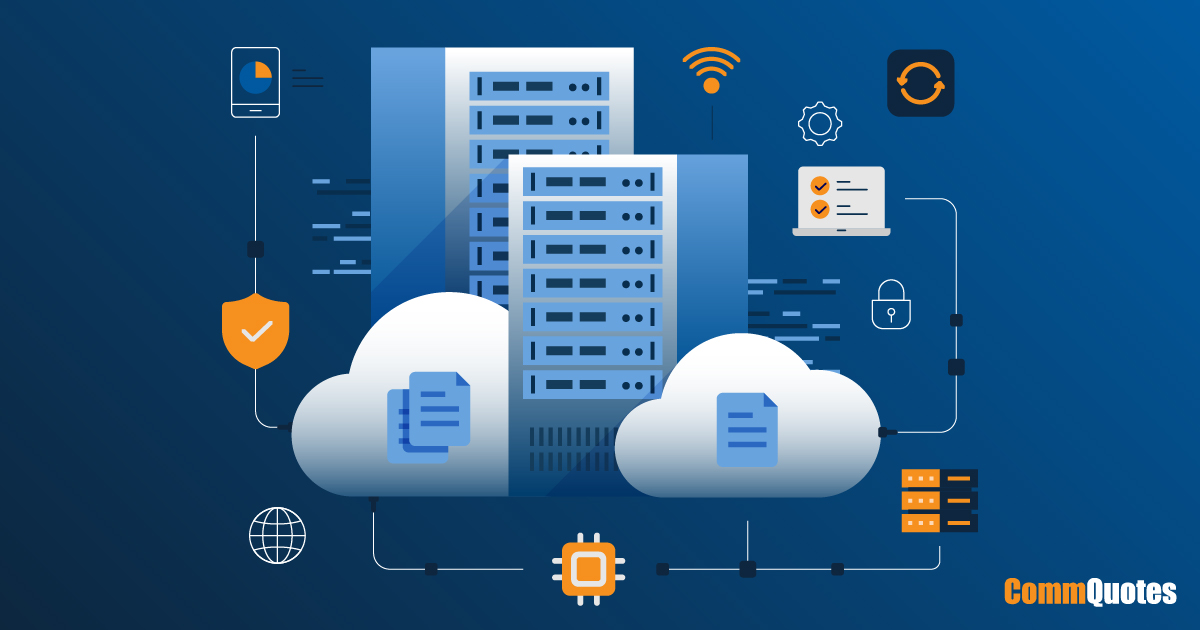
IaaS, short for infrastructure as a service, is when a third-party provider delivers virtualized computing resources over the internet. Instead of purchasing and maintaining physical servers, networking equipment, and data center space, businesses rent these resources on demand from a cloud provider.
It’s an increasingly popular option. The global IaaS market reached $190 billion in 2025,1 and experts expect it to continue growing as more organizations shift away from maintaining physical data centers. Essentially, you get the compute power and storage you need without the capital expense of buying the hardware or the operational burden of managing it.
What Is Infrastructure as a Service in Cloud Computing?
Cloud infrastructure as a service sits at the foundation of the cloud computing service stack. To understand where IaaS fits, it helps to look at the three primary cloud models:
- IaaS (Infrastructure as a Service): Delivers virtualized hardware for compute, storage, and networking functions. You manage the OS, middleware, and applications.
- PaaS (Platform as a Service): Adds a managed platform on top of infrastructure, so developers can deploy new apps without having to worry about the underlying environment.
- SaaS (Software as a Service): Delivers managed software applications accessible via browser or API, with no infrastructure or platform management required.
Infrastructure as a service in cloud computing is the lowest-level model, giving businesses the most control over their environment. That control comes with responsibility – your team still manages operating systems, security patches, and application configurations – but for many organizations, the tradeoff is worth it.
IaaS encompasses both public and private cloud environments. Public cloud IaaS (AWS, Azure, Google Cloud) shares resources across customers, while private cloud IaaS (11:11, Rapidscale, Tierpoint) is delivered by providers who manage dedicated cloud infrastructure for your organization.
%20Examples%20Benefits/commquotes-blog-whatisIaaS-inline1.jpg?width=851&height=350&name=commquotes-blog-whatisIaaS-inline1.jpg)
Private cloud means a dedicated provider handles the infrastructure management for you on dedicated hardware, so you get the benefits of IaaS without sharing resources with other customers. Private cloud providers often eliminate ingress and egress fees and offer more control over your environment than public cloud options, making them a compelling alternative as organizations reassess their infrastructure strategies amid changes like the VMware/Broadcom transition.
Not sure which approach is right for you? CommQuotes' agnostic advisors can help you evaluate your cloud solution options, including IaaS, PaaS, and SaaS, based on your actual needs rather than vendor marketing.
What Is IaaS in Cloud Computing vs. Traditional On-Premises Infrastructure?
The comparison to on-premises infrastructure is often what helps the IaaS meaning click for business leaders.
With traditional on-prem infrastructure, your organization is responsible for paying the full cost: hardware procurement, installation, power, cooling, physical security, maintenance contracts, and eventual replacement cycles. These are capital expenditures that require planning years in advance.
With cloud IaaS, it shifts to an operating expense model. There's no need to over-provision hardware to handle peak load – the cloud handles elasticity for you.
This is particularly relevant for businesses navigating telecom and connectivity decisions. At CommQuotes, we work with companies evaluating how their network infrastructure – circuits, bandwidth, SD-WAN, and more – fits into a broader cloud strategy. Understanding IaaS in cloud computing is often the starting point for those conversations.
IaaS Examples: Who Uses It and How
Let's ground this in the real world. Here are some of the most common IaaS examples, both in terms of providers and use cases.
IaaS Provider Examples
The IaaS market includes both public cloud and private cloud providers. Public cloud providers lead in market share, with Amazon Web Services (AWS) currently holding 30% of the global IaaS market, followed by Microsoft Azure (21%) and Google Cloud (12%).2 Other notable public providers include IBM Cloud, Oracle Cloud, and a growing number of regional and managed cloud providers.
%20Examples%20Benefits/commquotes-blog-whatisIaaS-inline2.jpg?width=851&height=350&name=commquotes-blog-whatisIaaS-inline2.jpg)
However, private cloud IaaS providers represent a significant and growing market segment. Companies like 11:11, Rapidscale, Tierpoint, and other managed cloud providers deliver dedicated cloud infrastructure with the same IaaS benefits – scalability, flexibility, and operational expense models – while avoiding the ingress and egress fees and resource sharing inherent in public cloud.
These providers offer everything from basic virtual machines and block storage to load balancers, virtual private networks, and dedicated connectivity options. The right provider depends on your existing tech stack, compliance requirements, geographic footprint, and budget.
Business Use Case IaaS Examples
- Disaster Recovery and Backup: Companies can use cloud infrastructure to replicate critical systems in the cloud without maintaining a secondary physical data center, resulting in faster and lower-cost disaster recovery.
- Development and Testing Environments: Engineering teams spin up temporary environments to test new features or applications, then tear them down when finished – paying only for the time used.
- Website and Application Hosting: Businesses host web applications on IaaS instead of dedicated servers, allowing automatic scaling during traffic surges without service interruption.
- High-Performance Computing: Research organizations and enterprises running complex data processing workloads leverage IaaS to access powerful compute resources on demand rather than investing in specialized hardware.
- Network Connectivity Extensions: Enterprises use IaaS-based virtual networking to extend their private network into the cloud – a use case where connectivity decisions and IaaS strategy are deeply intertwined.
At CommQuotes, we help organizations evaluate IaaS providers across multiple use cases simultaneously. Our team of vendor-agnostic experts brings market access and vendor relationships that ensure you're evaluating all viable options, not just the major hyperscalers.
5 Benefits of Infrastructure as a Service
So, why has cloud IaaS become such an important part of enterprise IT strategy? Here are some of the biggest benefits of switching to IaaS:
1. Cost Efficiency and CapEx Reduction
One of the most immediate IaaS benefits is that it lets you move from capital expenditure to operational expenditure.
Instead of budgeting for server hardware that may take years to depreciate, businesses pay for infrastructure usage on a subscription or consumption basis. This frees up capital and makes IT budgets more predictable and flexible.
2. On-Demand Scalability
IaaS makes it easy for businesses to scale resources up or down in minutes, not weeks. Whether you're preparing for a seasonal traffic spike, a product launch, or an unexpected growth surge, cloud infrastructure as a service means you're never stuck waiting for hardware procurement cycles to catch up with demand.
%20Examples%20Benefits/commquotes-blog-whatisIaaS-inline3.jpg?width=851&height=350&name=commquotes-blog-whatisIaaS-inline3.jpg)
3. Speed and Operational Agility
Provisioning a new server on IaaS takes minutes. On-prem, the same task could take weeks, from hardware ordering to racking, cabling, and configuring. That speed advantage adds up over time. It means faster product development, quicker responses to market opportunities, and reduced time to value for technology investments.
4. Improved Business Continuity
IaaS infrastructure inherently supports redundancy, since it’s distributed across multiple physical locations.
Providers typically offer multiple availability zones and regions, which makes it easier to build resilient systems that can survive hardware failures, regional outages, or natural disasters.
5. Freedom to Focus on Core Business
With IaaS, your infrastructure is managed by a cloud provider, so your internal IT team can spend less time on maintenance, patching hardware, and managing data center logistics. That time gets redirected toward higher-value work – building products, improving security posture, and supporting the business.
What To Watch Out for With Cloud IaaS
IaaS isn't a silver bullet. There are a few considerations businesses should think through before moving workloads to a cloud IaaS environment.
- Security and Compliance: IaaS follows a shared responsibility model. The provider secures the physical infrastructure; you're responsible for securing the OS, applications, data, and access controls. Compliance frameworks like HIPAA, PCI DSS, and SOC 2 require careful configuration.
- Cost Management: Without proper governance, cloud spend can spiral. Unused resources, over-provisioned instances, and redundant data transfers add up. Tagging, monitoring, and budgeting tools are essential.
- Connectivity Requirements: Moving workloads to IaaS doesn't eliminate your need for reliable, high-performance network connectivity – it often increases it. The connection between your offices or users and your cloud environment needs to be sized and structured appropriately. This is a core part of what we help clients evaluate at CommQuotes, comparing circuit options, SD-WAN solutions, and cloud-direct connectivity offerings.
- Vendor Lock-In: Migrating between IaaS providers can be complex and costly. Evaluating portability, multi-cloud strategies, and provider financial stability upfront can save significant pain later. Over 80% of organizations rely on multiple public cloud providers to avoid dependency on any single vendor.3
These considerations don't disqualify IaaS as a solution. Rather, they highlight areas where careful planning and ongoing management make the difference between a successful cloud strategy and an expensive problem.
%20Examples%20Benefits/commquotes-blog-whatisIaaS-inline4.jpg?width=851&height=350&name=commquotes-blog-whatisIaaS-inline4.jpg)
Align Your Infrastructure and Connectivity Strategy With CommQuotes
Understanding infrastructure as a service is the first step. The second is making sure your network and connectivity infrastructure can support wherever your cloud strategy takes you. IaaS environments depend on fast, reliable, secure connections – and those connections are rarely one-size-fits-all.
At CommQuotes, we help businesses navigate the telecom and connectivity decisions that sit alongside cloud infrastructure choices. Our agnostic advisors can help you compare your options and find solutions that fit your actual requirements – all while ensuring you get better-than-direct prices.
If your organization is moving to or expanding within an IaaS environment and you want to make sure your connectivity keeps pace, we'd love to help. Reach out today to start the conversation.
Sources: