TL;DR
-
A PBX (Private Branch Exchange) is a private phone network that routes calls inside an organization using extensions and connects employees to the public phone network or the internet for outside calls.
-
Modern PBX comes in traditional on-premises, hosted, virtual, and IP types, with the core choice being whether to run hardware on-site or move to a cloud-hosted system that lowers upfront cost and IT overhead.
-
On-premises PBX carries high upfront costs, often $5,000 to $50,000 or more, while hosted and cloud systems shift to a predictable fee of roughly $15 to $50 per user each month.
-
PBX security depends on configuration and maintenance, with toll fraud the most common threat and reputable hosted providers meeting standards such as SOC 2, HIPAA, or PCI DSS.
Business communication has come a long way from switchboards and copper wires, but the core need has never changed: organizations need a reliable, cost-effective way to manage phone calls across their teams and locations.
That's where PBX comes in. Analysts predict that the global PBX market will reach $12.4 billion in 2026,1 making this technology a foundational concept for businesses evaluating their phone infrastructure today.
Whether you're setting up a phone system for the first time or rethinking an existing setup, understanding what PBX is and which type fits your business can make a big difference in cost, flexibility, and day-to-day operations.
What Is PBX? A Brief Definition
PBX, short for Private Branch Exchange, is a private phone network used by an organization to manage calls. It allows employees to communicate internally using extension numbers and connects to the public switched telephone network (PSTN) or internet-based lines for external calls.
PBX Meaning in Plain Terms
If you've ever heard "press 1 for sales, press 2 for support" when calling a company, you've interacted with a PBX system. The auto-attendant, call routing, hold music, and extension dialing are all features managed by the PBX in the background.
For IT leaders and business owners, the PBX meaning goes beyond the dial tone: it's the infrastructure layer that determines how your entire organization communicates.
How Does a PBX System Work?
A PBX system acts as the internal switchboard for your organization. When a call comes in, the PBX routes it to the right extension, department, or voicemail based on the rules you've configured. Internally, employees can call each other using short extensions rather than full phone numbers, without the call ever leaving your private network.
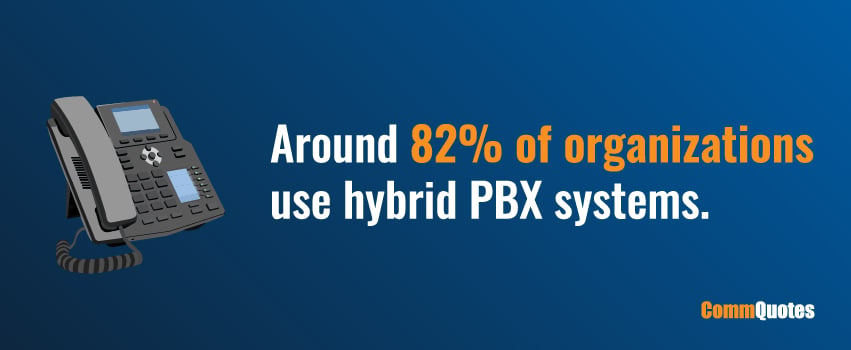
Traditional PBX managed this routing through on-premises hardware. However, around 82% of organizations now use hybrid PBX systems that combine cloud-based and on-premises elements2, which is where the different types of PBX systems come into play.
Types of PBX Systems
As with all tech investments, the right type of PBX phone system will depend on your business size, budget, IT resources, and growth plans. Let’s explore the primary types below.
Traditional (On-Premises) PBX
Traditional PBX systems involve physical hardware installed at your location. Your IT team manages the system, and calls are routed through dedicated phone lines. But while on-premises PBX offers strong reliability and control, it comes with high upfront costs and ongoing maintenance requirements.
Hosted PBX
A hosted PBX system moves the hardware and management off-site to a third-party provider, significantly reducing the burden on internal IT teams and lowering upfront investment costs.
At CommQuotes, our hosted PBX solutions connect you with top providers that simplify operations and reduce costs – without requiring you to become a telecom expert to evaluate them.
Virtual PBX
A virtual PBX is a cloud-based system that doesn’t require any on-premises hardware. It's usually a good fit for smaller businesses or distributed workforces that need professional call handling without a full PBX deployment.
IP PBX
An IP PBX routes calls over the internet using Voice over IP (VoIP) technology instead of traditional phone lines. IP PBX systems offer greater flexibility and are often more cost-effective, with businesses reducing their telecom costs by up to 50% after switching to a VoIP-based system.3
10 Key Features of a PBX Phone System
Modern PBX systems come packed with features that go well beyond basic call routing. Here's what most business PBX systems include:
- Auto-Attendant: Greets callers and sends them to the right department or extension
- Call Forwarding and Routing: Directs calls based on time of day, department, availability, or your own custom rules
- Voicemail-to-Email: Captures missed calls and delivers transcriptions or audio files directly to inboxes
- IVR (Interactive Voice Response): Lets your callers navigate menus using voice or keypad input
- Call Recording: Records calls for compliance, quality assurance, or training purposes
- Conference Calling: Enables multi-party calls without requiring a third-party service
- Extension Dialing: Allows internal calls between your employees using short codes
- Hold Music and Messaging: Allows you to customize what callers hear while waiting
- Ring Groups and Call Queues: Distributes incoming calls across teams to reduce wait times
- Reporting and Analytics: Provides visibility into call volume, duration, wait times, and more
The specific features available will vary by provider and system type, which is one of the reasons working with a vendor-agnostic advisor can help you avoid paying for capabilities you don't need or missing the ones you do.
PBX vs. VoIP: What's the Difference?
PBX and VoIP are related but very distinct concepts that often get used interchangeably.
PBX refers to the system architecture that manages and routes calls within your organization. It's the "switchboard" layer.
VoIP is the technology that IP-based phone systems use to send and receive calls over the internet rather than traditional phone lines.
Many modern PBX systems use VoIP as their underlying technology: these are often called IP PBX systems. But a PBX can also run over traditional phone lines (PSTN), and VoIP can be used without a full PBX system in place.
Understanding the difference matters when evaluating options, because the right combination of PBX architecture and transmission technology will depend on your infrastructure, call volume, and budget.
Key Benefits of a PBX Phone System for Businesses
When you implement a modern PBX phone system, you can expect to see benefits like:
Cost Savings
A PBX phone system consolidates communication onto a single system, allowing organizations to eliminate the need for individual external lines for every employee. Hosted and cloud-based PBX options further reduce costs by eliminating on-premises hardware and maintenance.
Scalability
Business PBX systems are designed to grow with your organization. Adding new users and locations is easier and less expensive than it would be with traditional phone lines, making PBX ideal for growing companies that need flexibility without constant infrastructure overhauls.
Remote and Hybrid Work Support
Modern hosted and cloud PBX systems support employees wherever they're working. Calls can be routed to mobile devices, softphones, or home offices seamlessly: a critical feature for today's distributed workforce.
Professionalism
Even a small business benefits from the professional call experience that PBX provides. Auto-attendants, call routing, and hold messaging give smaller organizations the same communication presence as much larger enterprises.
Centralized Management
A PBX system gives IT teams centralized control over the entire phone infrastructure. Changes to routing rules, extensions, or features can typically be made through a single admin portal rather than requiring vendor intervention or on-site work.
How Much Does a PBX System Cost? Pricing Explained
PBX pricing depends almost entirely on which type you choose. Traditional on-premises systems front-load your spending into hardware and installation, while hosted and cloud options shift that cost into a predictable monthly fee. Here is what each model typically looks like.
On-Premises PBX Costs
An on-premises PBX front-loads your investment. You buy the hardware, install it on-site, and cover ongoing maintenance yourself. The system itself often starts around $1,000 per user, and total upfront costs commonly run from about $5,000 to $50,000 or more depending on company size and call volume. Add IP desk phones at roughly $80 to $400 each, plus the cost of in-house or contracted IT support to keep everything running.
Hosted & Cloud PBX Costs
Hosted and cloud PBX flip that model. There is little or no hardware to buy, and you pay a per-user monthly fee that usually falls between $15 and $50, with maintenance and updates included. Entry tiers cover core calling and voicemail; higher tiers add analytics, CRM integration, and call recording. For most businesses under 100 employees, this subscription model costs less over a multi-year period than buying and maintaining on-site equipment.
What Drives the Final Price
Two systems with the same user count can still land at very different totals. The main variables are:
-
Number of users or extensions
-
Feature tier (basic calling vs. analytics, recording, and integrations)
-
One-time setup and number-porting fees
-
Devices (IP phones, headsets) and SIP trunking
-
Contract length and billing cycle (annual billing often lowers the per-user rate)
Because vendors rarely list every one of these in a single quote, comparing options on the headline seat price alone can mislead you. The number that matters is total cost of ownership across setup, monthly fees, and the features you will actually use.
Is a PBX Phone System Secure? Key Considerations
A PBX carries your organization's voice traffic, call records, and often customer data, which makes it a target worth protecting. Security depends less on whether a PBX is inherently safe and more on how the system is configured and who maintains it.
Common PBX Security Risks
The most common threats include:
-
Toll fraud, where attackers hijack your system to place expensive international or premium-rate calls on your bill. Regulators including the FCC have warned businesses about scams that exploit legacy PBX systems this way.
-
Eavesdropping on unencrypted VoIP calls, which can expose sensitive conversations.
SIP-based attacks, such as denial-of-service floods or brute-force attempts on weak extension passwords. -
Physical access to on-premises hardware, which is only as secure as the room it sits in.
Hosted vs. On-Premises Security
Where your PBX lives changes who owns the risk. With an on-premises system, your team handles patching, firewalls, and physical security. With a hosted or cloud PBX, a reputable provider secures the infrastructure, applies updates automatically, and usually runs data centers that meet standards like SOC 2, HIPAA, or PCI DSS. For many smaller teams, a well-run hosted system is more secure than an on-premises setup they lack the staff to maintain.
What to Look For in a Secure PBX
When you evaluate providers, confirm the system includes:
-
Encryption for calls and data in transit (TLS and SRTP)
-
Firewalls or a session border controller to filter malicious traffic
-
Strong user authentication with role-based access controls
-
Compliance certifications relevant to your industry, such as HIPAA for healthcare or PCI DSS for payment data
Security rarely comes down to a single feature. The real question is whether a provider's safeguards match your risk profile and the regulations your business answers to.
How To Choose the Right Business PBX System
When you’re comparing PBX systems, the goal is to find a solution that aligns with your operational needs, scales with your growth, and doesn't waste money on capabilities you won't use.
Small Businesses
A PBX system for small business use doesn't need to be complicated, but it does need to be right-sized. Here's what small and mid-sized businesses should evaluate when choosing a PBX:
- Total Cost of Ownership: How much will setup, licensing, hardware (if applicable), and ongoing maintenance cost?
- Scalability: Will the system grow with your business without requiring a full replacement?
- Required Features: Will you be overpaying for enterprise features your teams won't use?
- Vendor Support: What does post-sales support look like if something goes wrong?
The challenge for small businesses is that the PBX market is crowded, and every vendor claims to be the best fit. That's where having an independent advisor like CommQuotes on your side makes a real difference.
Enterprises
The stakes are higher for larger organizations, and so is the complexity. These systems need to handle higher call volumes, support multiple locations, integrate with enterprise software, and meet specific compliance requirements.
A few key considerations for enterprise PBX selection include:
- Multi-Site Support: Can the system connect offices across geographies seamlessly?
- Redundancy and Uptime: What SLAs does the provider offer, and how do they handle failover?
- Compliance Capabilities: Does the PBX include features that simplify audit readiness for specific compliance requirements?
- Analytics and Reporting: Will your teams have visibility into communication patterns and performance?
- Integration Depth: Can the system integrate with Microsoft Teams, Salesforce, and other enterprise platforms?
At CommQuotes, we work with businesses of all sizes to evaluate and source the right PBX solution – without vendor bias and at better-than-direct pricing. Our team has helped organizations navigate everything from simple hosted PBX deployments to complex multi-site migrations, and we stay involved through implementation and beyond.
What is a PBX FAQs
What's the difference between a PBX and a PABX?
A PBX (Private Branch Exchange) and a PABX (Private Automatic Branch Exchange) are essentially the same thing. The difference is historical: early PBX systems needed a human operator to connect calls, while a PABX automated that switching. Because automation is now standard on every business phone system, the two terms are used interchangeably. If a vendor quotes you a PABX, you can treat it as a modern PBX.
How does a PBX phone system compare to UCaaS?
A PBX handles your organization's calls: routing, extensions, and voice features. UCaaS (Unified Communications as a Service) is a broader cloud platform that bundles calling with video meetings, messaging, and collaboration in one subscription. Many UCaaS platforms use cloud PBX functionality as their calling layer, so the two are not competitors. If you only need voice, a hosted PBX may be enough. If you want voice, video, and chat unified, UCaaS is usually the better fit.
How many users can a PBX phone system support?
It depends on the type. Traditional on-premises systems are capped by their hardware, so scaling up means adding physical cards, lines, or an entirely new cabinet. Hosted and cloud PBX systems are far more flexible: because capacity lives in the provider's data center, most support anywhere from a handful of users to several thousand, and you add or remove seats through an admin portal. For growing companies, that scalability is one of the main reasons to choose a cloud-based system.
Can I use my existing phones with a PBX system?
Often yes, but it depends on the phones and the system. Most VoIP-based PBX systems work with standard IP desk phones and softphones, so compatible hardware usually carries over. Older analog phones typically need an adapter (an ATA) to connect to a modern IP PBX, and in some cases they are better replaced. Before switching providers, confirm which of your current devices are supported so you can budget for any replacements up front.
What's the difference between IP PBX and VoIP PBX?
There isn't one. IP PBX and VoIP PBX describe the same kind of system: a PBX that routes calls over the internet using Voice over IP instead of traditional phone lines. The terms are used interchangeably across the industry. Both contrast with a traditional analog PBX, which connects calls through dedicated copper lines and on-site switching hardware.
Do IP phones require a PBX to function properly?
IP phones can place and receive calls without a PBX, but they work best with one. On their own, each phone operates in isolation, missing the centralized routing, extension dialing, auto-attendant, and call management that businesses rely on. A PBX ties your phones into a single system so calls move cleanly between employees, departments, and outside lines. For anything beyond a couple of standalone lines, a PBX is what makes the phones behave like a real business phone system.
What replaced the traditional PBX phone system?
IP PBX and cloud-based systems have largely replaced the traditional analog PBX. Instead of routing calls over copper lines through on-site hardware, modern systems use Voice over IP to carry calls across the internet, which lowers costs and adds features like mobile apps, voicemail-to-email, and CRM integration. Many businesses now go further with UCaaS platforms that fold PBX calling into one tool alongside video and messaging. The term PBX has stuck, even though the technology behind it has changed.
Find the Right PBX Phone System With CommQuotes
Understanding PBX is one thing, but navigating the market to find the right system at the right price is another challenge altogether. With so many hosted PBX providers, IP PBX vendors, and cloud communication platforms competing for your attention, it's easy to end up overpaying for the wrong solution or locked into a contract that doesn't serve your business.
That's exactly what CommQuotes is built to solve. Our team of vendor-agnostic experts assesses your communication needs, compares top PBX providers across our portfolio of 800+ suppliers, and delivers honest recommendations – all at no cost to you.
Ready to make a confident, cost-effective decision about your business communications? Connect with CommQuotes today to get started.
Sources:
- https://www.futuremarketinsights.com/reports/pbx-market
- https://www.frost.com/growth-opportunity-news/information-communications-technology/unified-communications/best-practices-of-28-ucaas-providers-across-north-america-tgc-fr-cim-rg
- http://fortunebusinessinsights.com/voice-over-internet-protocol-voip-market-110830