TL;DR
-
The CPaaS vs UCaaS choice comes down to a toolkit versus a finished product: CPaaS gives developers APIs to build communication into your own apps, while UCaaS is a ready-to-use platform your team logs into.
-
Choose UCaaS when you want to communicate better as a business with a ready-made system, and choose CPaaS when you're embedding communication features into a product you're building.
-
CPaaS and UCaaS aren't mutually exclusive, and many organizations run UCaaS for internal collaboration alongside CPaaS for customer-facing features, sometimes adding CCaaS for the contact center.
Business communication technology has produced no shortage of "as a service" acronyms, and CPaaS and UCaaS are two of the most frequently confused. Both are cloud-based. Both deliver voice, messaging, and video capabilities. But they solve fundamentally different problems – and picking the wrong one can mean building something your business didn't actually need.
This guide breaks down CPaaS vs UCaaS: what each one is, how they differ, and how to decide which approach (or combination) fits your business.
What Is CPaaS? CPaaS Meaning
CPaaS, which stands for communications platform as a service, is a cloud-based platform that gives developers the building blocks – APIs and SDKs – to embed communication features like voice, video, SMS, and messaging directly into their own applications and workflows.
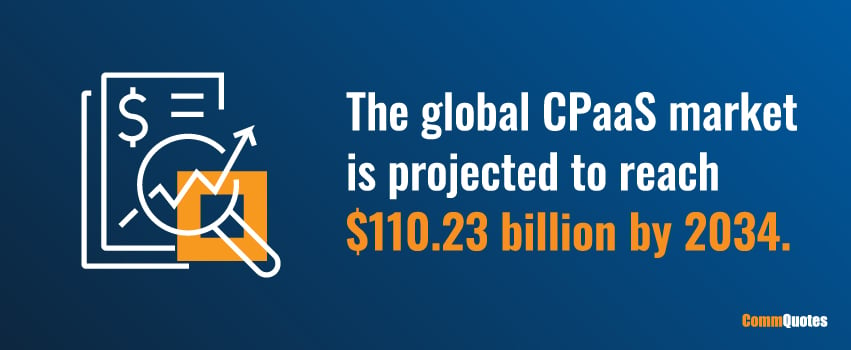
The CPaaS meaning is best understood through what it enables. Instead of buying a pre-built communication tool, your development team uses CPaaS to add the communication features your product needs, exactly where you need them. The approach is gaining traction, with the global CPaaS market projected to grow from $27.17 billion in 2026 to $110.23 billion by 2034.¹
How CPaaS Technology Works
CPaaS technology works through APIs (Application Programming Interfaces) that let your software "talk" to cloud-based communication infrastructure.
Rather than deploying a standalone app, your developers can use CPaaS to write code that triggers communication actions, such as sending a text, placing a call, or launching a video session, directly from within your product.
CPaaS Platforms and Capabilities
CPaaS platforms typically offer support for features like:
- Voice APIs for inbound and outbound calling
- SMS and messaging APIs for text-based communication
- WebRTC for embedding real-time voice and video into websites and apps
- Two-factor authentication and verification tools
- Conversational AI for building chatbots and automated interactions
- Number masking for privacy-protected communication between users
CPaaS Examples
CPaaS examples are everywhere once you know to look for them.
For instance, consider a rideshare app that lets a driver and passenger call each other without exchanging phone numbers, or a delivery notification that texts you a tracking link.
In both cases, communication isn't a separate app that the user opens. It’s embedded directly into the experience they're already using via CPaaS.
Who Actually Needs Communications Platform as a Service (CPaaS)?
Not every business needs CPaaS. Communications Platform as a Service makes the most sense for organizations building or maintaining a customer-facing product, embedding voice, video, or messaging into an existing workflow, or working with a dev team capable of implementing APIs. If none of that describes your situation, UCaaS is almost certainly the better starting point.
What Is UCaaS?
UCaaS, short for unified communications as a service, is a cloud-delivered platform that bundles voice calling, video conferencing, team messaging, and collaboration tools into a ready-to-use application for your organization.
Unlike CPaaS, UCaaS isn't something your developers build with. It's a finished product your employees log into. Think phone system, video meetings, and team chat, unified under one login and interface.
CPaaS vs UCaaS: The Core Differences
The clearest way to understand CPaaS vs UCaaS is that CPaaS is a toolkit that developers use to build custom communication features, while UCaaS is a finished platform for everyday internal and external communication.
Here’s a quick look at what the biggest differences are between these technologies:
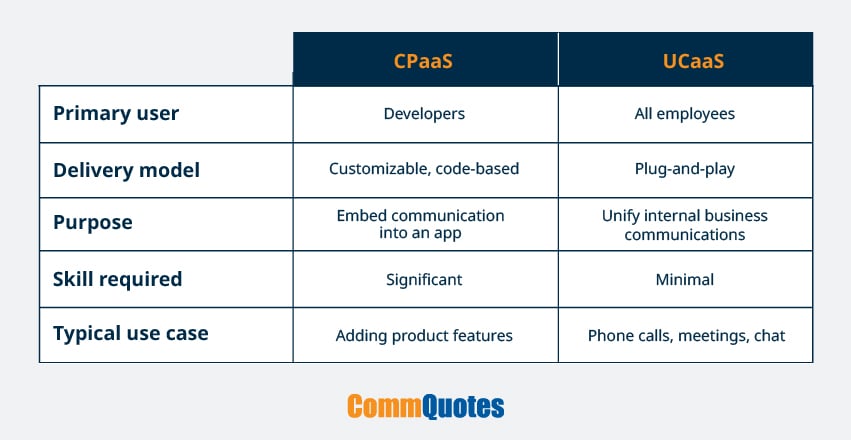
Put simply, if you're building communication into something you're creating, you want CPaaS. If you're looking for a ready-made system your team can start using tomorrow, you want UCaaS.
UCaaS vs CCaaS vs CPaaS: Where Does the Third Acronym Fit?
Rounding out the picture, UCaaS vs CCaaS vs CPaaS often comes up as a three-way comparison, and it's worth clarifying where each one lives:
- UCaaS unifies internal communication for your entire organization – voice, video, chat, collaboration.
- CCaaS is purpose-built for customer-facing support and service teams, with intelligent routing, omnichannel support, and workforce management.
- CPaaS is the developer toolkit for embedding communication features into your own applications and products.
Many organizations end up using more than just one of these. A UCaaS platform might handle internal collaboration, a CCaaS solution manages the contact center, and CPaaS APIs power communication features embedded in a customer-facing app – three different tools solving three different problems.
If you're not sure which of these your business actually needs, CommQuotes can help you map your requirements to the right mix and compare providers in each category, all at no cost to you.
CPaaS vs UCaaS: Which Is Right for Your Business?
The decision usually comes down to one core question: are you trying to communicate better as a business, or build communication into a product you're creating?
Choose UCaaS if:
- You need a company-wide phone, video, and messaging system
- Your team wants a ready-to-use platform without custom development
- You're replacing a legacy phone system or consolidating scattered tools
Choose CPaaS if:
- You're building a product that needs embedded communication features
- You have development resources to implement and maintain APIs
- Your use case requires more customization than a standard UCaaS platform allows
Consider both if:
- Your organization needs strong internal communication and customer-facing communication features built into your own product

How To Evaluate CPaaS Providers and UCaaS Platforms
Comparing CPaaS providers or UCaaS platforms feature-by-feature is time-consuming, and vendor marketing rarely makes it easy to see through the noise. Whether you're comparing CPaaS providers or UCaaS platforms, a few evaluation principles hold across both:
Documentation and Support Quality
Documentation and support quality matter enormously for CPaaS, where your developers will be doing the implementation work.
Network Reliability
Reliability and network diversity matter enormously for UCaaS, where your entire team depends on uptime.
Security and Compliance
Security and compliance capabilities should be non-negotiable for both, particularly in regulated industries.
Total Cost of Ownership
Total cost of ownership varies significantly – CPaaS pricing is usage-based, while UCaaS is typically per-user, per-month.
CPaaS vs UCaaS FAQs
What is the difference between CPaaS and UCaaS?
CPaaS is a toolkit; UCaaS is a finished product. CPaaS gives your developers APIs and SDKs to build communication features like voice, video, and SMS directly into your own applications. UCaaS is a ready-to-use platform your employees log into for calling, video meetings, and team chat, with no development work required. In short, CPaaS is something your developers build with, while UCaaS is something your team logs into and uses as is.
What is the difference between UCaaS, CCaaS, and CPaaS?
Each one solves a different problem. UCaaS unifies internal communication across your organization, bringing voice, video, chat, and collaboration into one platform. CCaaS is purpose-built for customer-facing support teams, with intelligent routing, omnichannel handling, and workforce management. CPaaS is the developer toolkit for embedding communication features into your own applications. They aren't mutually exclusive, and many organizations run all three: UCaaS for internal collaboration, CCaaS for the contact center, and CPaaS APIs powering communication inside a customer-facing app.
Can you use CPaaS and UCaaS together?
Yes, and many businesses do. The two cover different parts of your communication stack, so they complement each other rather than compete. UCaaS handles internal collaboration, your team's phone system, video meetings, and messaging, while CPaaS powers custom, customer-facing features embedded in your own product. A combined setup makes sense when you need reliable day-to-day internal communication and also want tailored communication built into an application. If your organization has both non-technical staff and a development team, running both is often the practical choice.
Do I need developers to use CPaaS?
Yes. CPaaS is built around APIs and SDKs, so it assumes you have a development team that can implement and maintain the integrations. Without that in-house capability, most of what makes CPaaS valuable is hard to put to use. UCaaS is the opposite: it's a prebuilt platform your team logs into, with no coding required. If you don't have development resources, or don't want to tie them up on communication features, UCaaS is almost always the better starting point.
Is CPaaS or UCaaS more cost-effective?
It depends on how you consume communication. CPaaS pricing is usage-based, so you pay per API call, message, or minute, which can be economical at low or variable volume but climbs as usage grows. UCaaS is typically priced per user, per month, so costs scale with headcount and stay more predictable for a growing team. Neither is cheaper by default. Forecast your expected usage and team size, then compare the two models against how your business actually communicates.
What is CPaaS used for?
CPaaS is used to embed communication directly into the apps and workflows you already run, instead of adding a separate tool. Common examples include a rideshare app that connects a driver and passenger by phone without exchanging numbers, a delivery service that texts a tracking link, or an app that sends two-factor authentication codes. Developers pull in features like voice, SMS, video, or number masking through APIs, so the communication happens inside the experience your customers are already using.
How do I choose between CPaaS and UCaaS?
Start with one core question: are you trying to communicate better as a business, or build communication into a product you're creating? If you need a company-wide phone, video, and messaging system that's ready to use, choose UCaaS. If you're embedding communication features into your own application and have the development resources to build and maintain them, choose CPaaS. Also weigh your timeline and how much customization you actually need, since UCaaS deploys fast while CPaaS trades speed for flexibility.
Find the Right Fit With CommQuotes
CPaaS and UCaaS solve different problems, and getting the choice wrong – over-customizing when a simple platform would do, or under-building when your product truly needs embedded communication features – is a costly mistake to walk back.
At CommQuotes, our team helps businesses evaluate their communication needs and compares top UCaaS platforms and CPaaS providers across our portfolio of 450+ vetted suppliers, delivering honest, vendor-agnostic recommendations at better-than-direct pricing and zero cost to you.
Whether you need a unified communications platform for your team or a developer-ready toolkit to build into your product, we're here to help you choose with confidence. Connect with our team today to get started.
Sources: